
Columbia Resident Lookup Records
One person can appear in several Columbia record systems for unrelated reasons. The Boone County Assessor report is the best starting point for a recorded owner or tax-mail contact. It is not a list of everyone at an address. The Clerk's voter tool can test a known name and birth date. Case.net can identify a public court party, while an archival death index or Recorder marriage index can establish a historical event. Treat every return as evidence with a date and a field label, not as a complete portrait of a person.
| Record | What it can confirm | Columbia route | Access |
|---|---|---|---|
| Assessor parcel report | Recorded owner, situs, mailing address, parcel link | Boone Assessor | Free name, address, or parcel search |
| Voter confirmation | Whether a known name and birth date match a registration record | Boone County Clerk | Name and birth-date tool, not a street roster |
| Court index | Public party, case number, date, and case status | Missouri Case.net | Remote index and clerk-file fallback |
| Death or marriage trail | Historical death event or marriage-index lead | Missouri Archives and Boone Recorder | Death index is public; copies have limits |
| License or business filing | Official professional or entity connection | Missouri Professional Registration | Public verification varies by register |
For a current property connection, begin with the Assessor. For a court matter, start with the case number or a tightly narrowed name. For family history, use the death index, obituary, directory, or yearbook trail first. The order matters because it limits same-name errors and avoids treating a legal, tax, or mailing address as a current home address.
Build Columbia Lookup Anchors
Before running a Columbia resident lookup, write down the full name, middle initial, suffix, alternate spellings, approximate age, known street, and time period. Then pair the name with a second anchor. Useful pairs include a name plus a parcel or legal description, a name plus birth date in the voter tool, a name plus county and death year, or a name plus a court case number. A name alone is only a lead. Mailing, situs, voter, court, and registered-agent addresses are separate field types and should stay separate in notes.
The Assessor can show a taxable-property relationship and a mailing address that differs from the physical parcel. A deed proves a recorded transfer, not occupancy. A case docket can place a person in a legal matter, but does not establish where that person lives now. If a record seems wrong, ask the original custodian about its correction process instead of repeating the result elsewhere.
- Situs address
- The physical location of a parcel used by the Assessor and map systems.
- Mailing address
- The address used for tax notices. It may belong to an owner, trustee, business, or prior record contact.
- Two-anchor match
- A match supported by a second fact, such as a birth date, parcel, court number, or event date.
Note: A no-match can reflect a spelling change, a protected record, an unindexed source, or the wrong county rather than proof that the person was never in Columbia.
Use Columbia Case.net Records
Missouri Case.net is the statewide public court index for a Columbia name search. The official search guide identifies litigant-name, filing-date, case-number, and scheduled-hearings modes. A case number is the most precise option. Name searching does not return every person mentioned in a filing, and a result should be narrowed by court, party role, date, and the person’s known timeline. The live portal was security-blocked during research, so current button text and result limits should be checked on the official service.
| Case header | Case number, court or location, case type or division, filing date, and public party names. |
|---|---|
| Public docket | Docket entries, scheduled events, and public judgment or disposition details when available. |
| Restricted material | Secure documents, juvenile matters, sealed or expunged cases, and protected parties may be omitted or locked. |
| Local fallback | The Boone County Circuit Clerk holds local files and copy-request routes when a public case needs a specific document. |
The 13th Judicial Circuit copy request form covers documents, audio, and transcripts and requires valid photo identification. Older paper or archived work may require the clerk, even when a later case can be found online. Columbia Municipal Court is a separate local route for ordinance matters. Neither court system is a resident list.
Note: A court result can establish a public case connection, but it cannot prove a current Columbia address without a separate, dated record.
Confirm a Columbia Voter Lookup
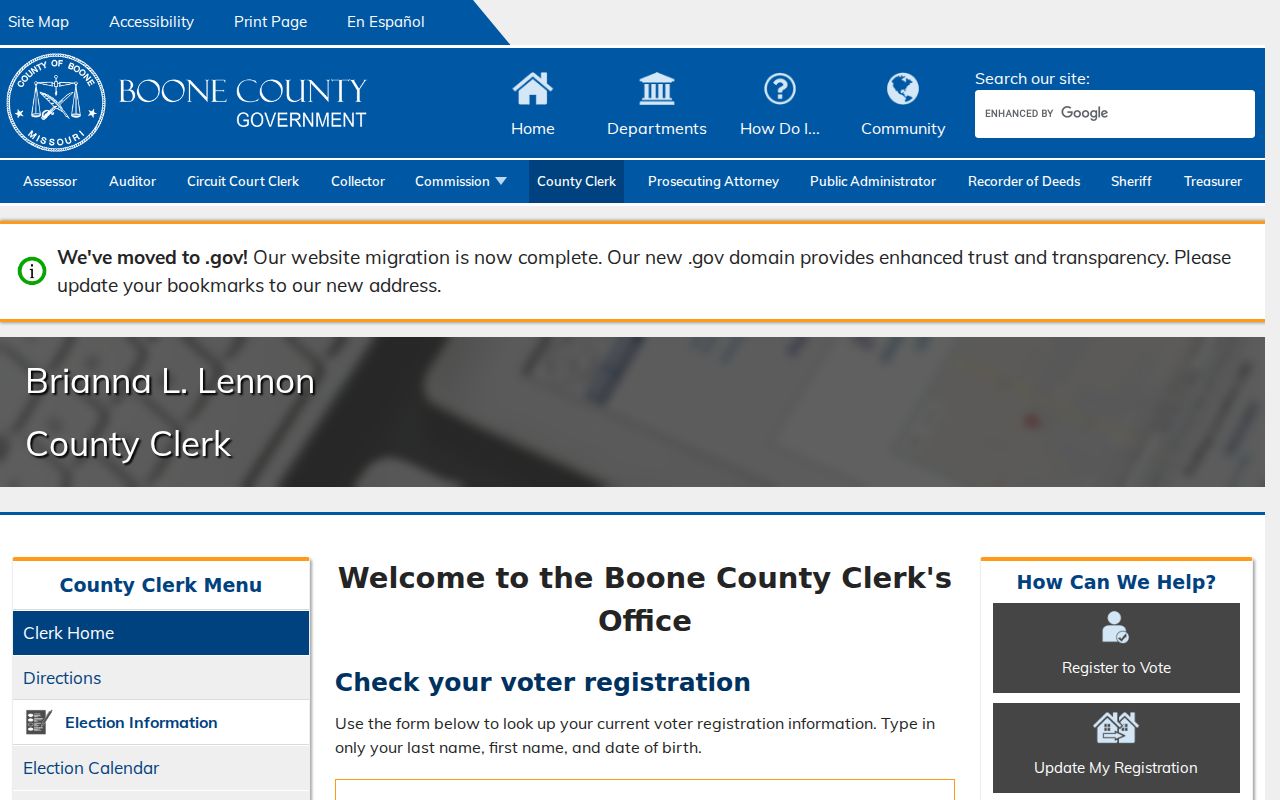
The Boone County Clerk's Registered Voter Search is designed to confirm a person, not to reveal a block or street. Its public form uses a search type, last name, optional first name, and date of birth. The Clerk's guidance says that a first-name entry can narrow a result. Use a known birth date when possible, then keep the result within the limits of the election record. Do not turn a registration match into a claim about every person at an address.
The Clerk's form shows the name and birth-date fields used for a Columbia resident lookup.
Missouri law permits certain computerized voter information, but Boone's public tool remains a controlled name-and-date confirmation route. A full-file request, release rules, and protected-address suppression are separate matters handled by the Clerk.
Verify a Columbia Resident Lookup
Use the least intrusive official source that answers the question, then confirm it with an independent record. A parcel may establish a property link. A voter match can help distinguish a common name. A public court header can add a case number and date. Historical death, marriage, directory, or obituary material can supply a family or time anchor. This sequence keeps the resident lookup tied to the actual purpose of each record.
- Normalize the name with a middle initial, suffix, spelling variants, a known place, and a time range.
- Search the Assessor when a Columbia property link is plausible, and record the owner, situs, mailing address, parcel, and date separately.
- Check a second source that has a different field, such as a known-date voter confirmation, Case.net header, Recorder transaction, or death-index result.
- When an official copy is necessary, request it from the Recorder, Circuit Clerk, or DHSS rather than relying on a search screen.
- Docket
- The chronological list of entries made in a court case, such as filings, hearings, and public outcomes.
- Index versus image
- An index helps locate a record. An image is the scanned document itself and may have different access rules.
- Certified copy
- A copy issued or certified by the record custodian for an official purpose, subject to that office's requirements.
Keep a short log of the search date, source, field used, and reason each result matched. It makes later correction or verification with the custodian much easier.
Check Columbia Vital Records
Vital records have a different access model from a Columbia resident lookup. The Missouri DHSS Bureau of Vital Records does not open current birth, death, marriage, or divorce copies to the general public. Certified copies require an eligible relationship, direct and tangible interest, identification, and the required application process. Mail applications must be notarized. The state holds birth and death records from 1910 forward, while local short-form access is narrower.
For family research, the Missouri Archives death-certificate index covers 1910 through 1975 and permits searches by name role, matching mode, year range, and county. Death records over 50 years are the public genealogy route. Boone Recorder's marriage index reaches 1865 forward, but marriage images are not online. DHSS issues a marriage or divorce statement, while the Boone Recorder holds the marriage certificate and the Circuit Clerk holds the divorce decree.
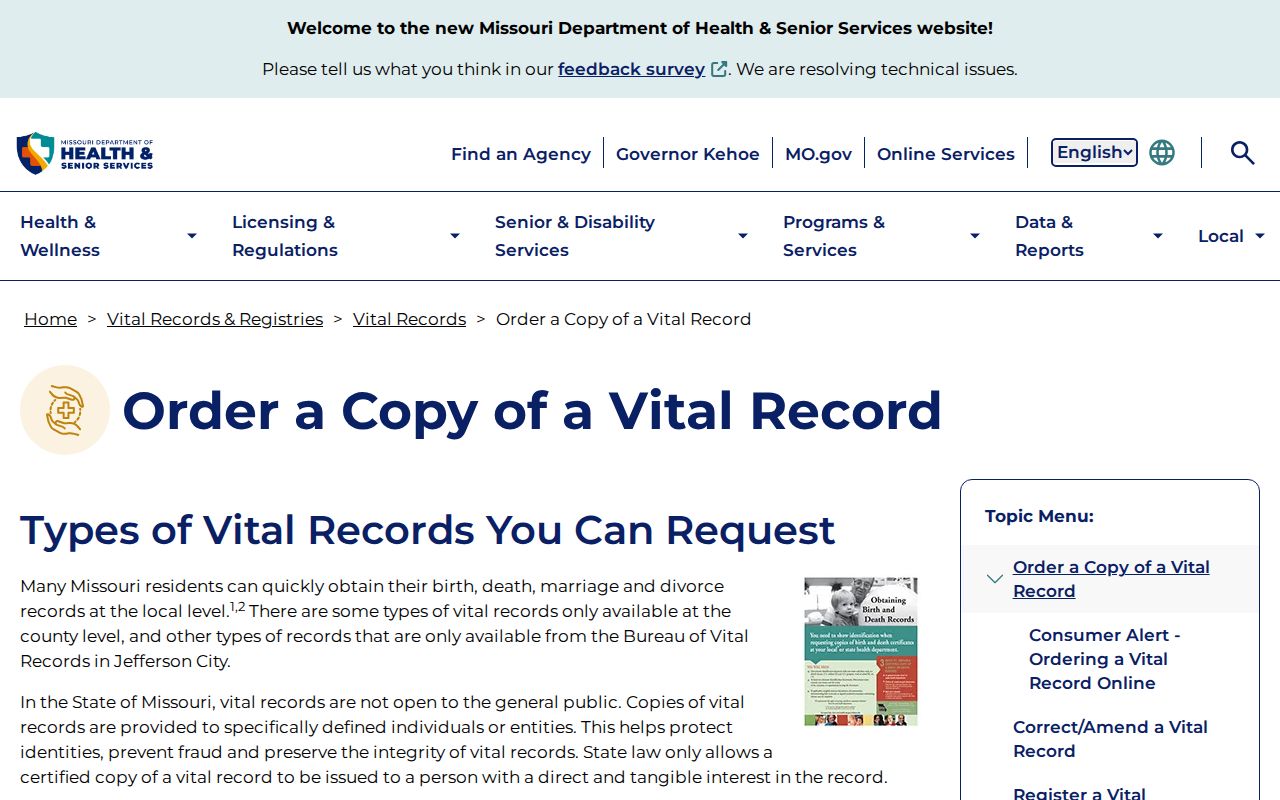
The official DHSS order page identifies the eligibility and application route for a Columbia resident lookup that reaches a vital event.
A historical index result can support a name and date, but it does not replace the custodian's certificate or decree. A five-year search applies per DHSS fee, and the office should be contacted for current processing details.
Columbia Recorder Index Quirk
The Boone Recorder can help when a Columbia resident lookup includes a property transfer, marriage index, lien, or recorded legal document. Its name search separates the direct grantor index from the indirect grantee index. The historical index has a local filing convention: for surnames A through F, search the first letter; for G onward, search the first letter plus a vowel. The Recorder gives Smith as the example, filed under SI. Trying the right index direction and this letter rule can resolve a name search that initially looks empty.
Boone Recorder online services provides the index trail back to 1821. Real-estate images are available online from 1965 forward, while earlier image work may require a subscription or public terminal. The coverage split is about document access, not proof that no earlier record exists.
Note: For a property question, compare the Recorder's legal description with the Assessor parcel rather than relying on a surname alone.
Columbia License and Entity Checks
When a person is known through a business or regulated profession, a resident lookup can use an official affiliation as another identity anchor. The Missouri Secretary of State entity search can return an entity name, status, formation date, previous names, and registered-agent information. Exact spacing and punctuation matter, and the state advises starting with as little information as possible. A registered-agent address is a legal notice address, not a personal residence.
Missouri Professional Registration can show a licensee name, profession, license number, status, issue or expiration dates, and posted discipline. Board coverage varies, and older or inactive detail may require the board. These registers confirm an official filing or credential, not where a person lives.
Legal Limits on Columbia Lookup
Missouri keeps access limits record by record. Case.net excludes or restricts sealed, expunged, juvenile, secure, and protected material. Vital records require eligibility. The voter system can suppress or substitute protected addresses. The Missouri Safe at Home program provides a substitute address and mail forwarding for eligible survivors, and the local election authority does not receive a participant's confidential residential address. An absence from an ordinary address trail may be a protection feature, not an error.
For a non-exempt record that is not online, Missouri's Sunshine Law request guidance is the fallback. A written request can identify the name variants, record type, date range, and requested delivery format. Under RSMo 610.023, the custodian responds as soon as possible and no later than three business days, or explains the delay. Closed information must be segregated from open material.
Lawful use. Use Columbia records for personal history, family research, civic transparency, or a specific lawful question. Using record details to stalk, harass, monitor, or intimidate a person can violate Missouri law.