
Columbia Previous Residents Sources
Use the period in question to choose a source. The deed chain records legal transfers. Address and reverse directories can identify a dated household. Census records capture a household on an enumeration date, while permits and Sanborn maps describe the structure or parcel rather than the people inside it. Columbia previous residents research becomes more reliable when these independent sources point to the same address and date range.
| Columbia address source | Years it covers | Where held | What it can show |
|---|---|---|---|
| Boone Recorder real-estate images | 1965-present | Boone iCounty or public terminal | Deed parties, dates, book/page, and legal description |
| Boone handwritten deed index | 1821-1965 | Recorder index, office, or terminal | Grantor and grantee trail; older images have access limits |
| SHSMO Recorder records C3306 | 1820-1929 | State Historical Society of Missouri | Land grants, deeds, wills, and mortgages |
| Columbia city directories | 1907-1940 selected early runs; 1936-2013 with gaps | DBRL and local collections | Address, household, occupation, and status clues |
| Federal census | 1790-1950 public | DBRL HeritageQuest and Census resources | Enumerated household on a census date |
| Sanborn maps | 1889 sample; 1908-1948 local series | MU Special Collections | Building footprint, use, material, and street labels |
| Local obituaries | 1938-1965 collection; Tribune from 1901 | CoMo Preservation and DBRL | Death dates, relatives, and printed local details |
Start with the Assessor and Recorder for a recent ownership question. For a household before the online deed-image period, move to the Recorder index, the library's physical volumes, and archives rather than treating a blank web-image result as the end of the record.
Start at a Columbia Parcel
The Boone Assessor property reports provide the modern anchor for a Columbia address history. Search by owner, address, or parcel. Retain the current owner, physical situs, mailing address, parcel number, and legal description separately. The situs is the parcel's physical location. The mailing address is where the county sends notices, and it may belong to an owner, trust, business, estate, or representative somewhere else.
Once the parcel is located, the Boone parcel viewer can confirm the map geometry and provide aerial context. Current tax information is a starting point only. It does not prove that an owner lived at the property, and it does not name every past resident.
The parcel record may also carry assessed values, tax classifications, or exemption flags. Treat those as tax-roll information, not proof of a household's circumstances. A reliable note pairs the reported parcel with the date searched and the source used. The legal description is the durable key when the street address has a different abbreviation, a former name, or a boundary-era variation.
Columbia Previous Residents Deed Trail
The Boone Recorder online-services page explains the ownership trail behind a Columbia address. Use the current owner as a grantee in the indirect index around the acquisition date, then open the deed record and match its legal description. The seller named in that deed becomes the next person or entity to search as an earlier grantee. Repeat the same-parcel test each time. A deed chain follows legal transfers, so it complements but does not replace evidence of who lived at the address.
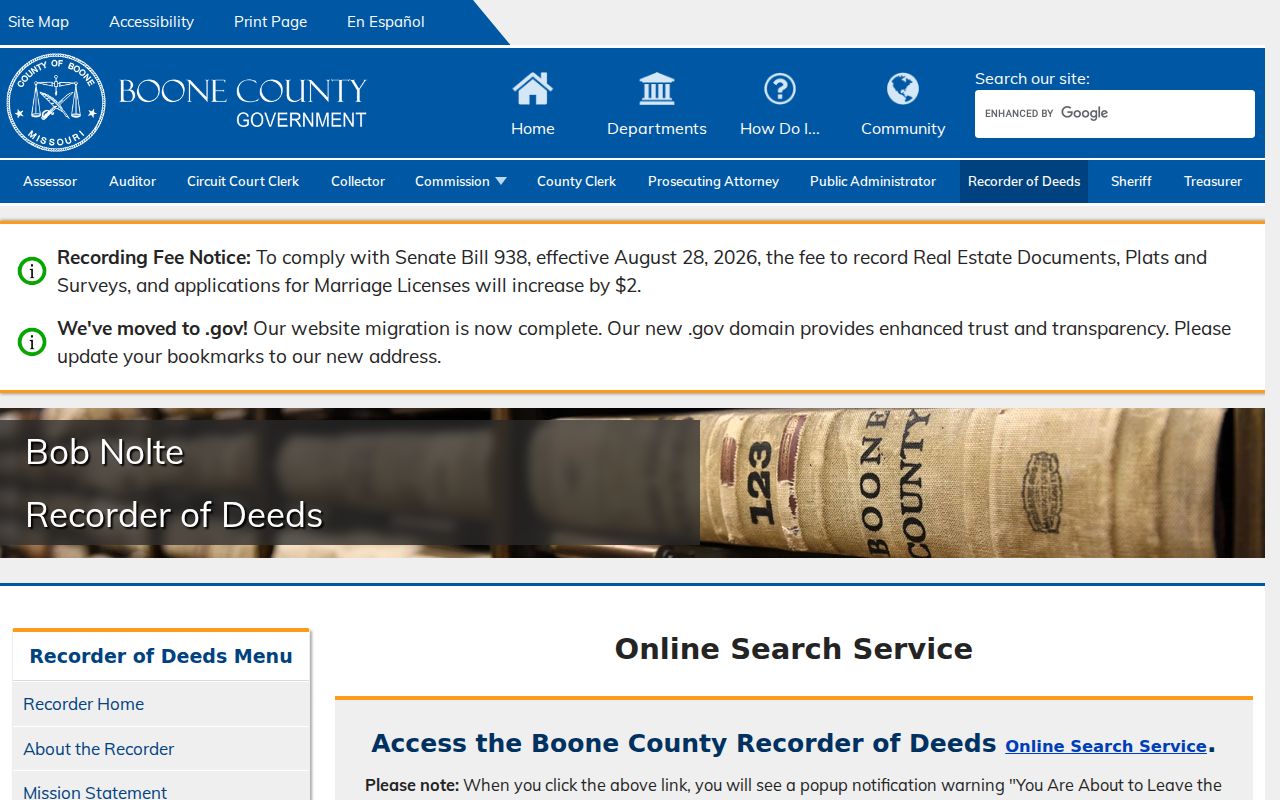
The Recorder index distinguishes grantor and grantee directions and allows book and page work. Recording the index direction avoids reversing the trail when moving from a current owner to a prior owner.
- Copy the current parcel number, legal description, and owner from the Assessor report.
- Find the owner's acquisition as a grantee or indirect-index entry and note the recording date, book, page, and instrument.
- Open the deed image when it is available and match the same legal description, lot, block, or subdivision language.
- Search the seller from that transfer as a grantee in the earlier period, including variant spellings, trusts, estates, spouses, and business forms.
- Continue backward until the online image period ends, then use the handwritten index, terminal, office, or archive route.
- Grantor
- The party transferring an interest in land, commonly the seller in a deed.
- Grantee
- The party receiving an interest in land, commonly the buyer in a deed.
- Chain of title
- The sequence of documented land transfers for the same legal parcel.
- Legal description
- The recorded lot, block, subdivision, or boundary language that identifies land more reliably than an old street form.
The Recorder's instrument-code reference helps classify what appears in a Columbia previous residents deed trail. Warranty deeds, quitclaim deeds, sheriff's deeds, and trustee's deeds are transfer candidates, while releases, satisfactions, surveys, plats, and restrictions answer different land-record questions.
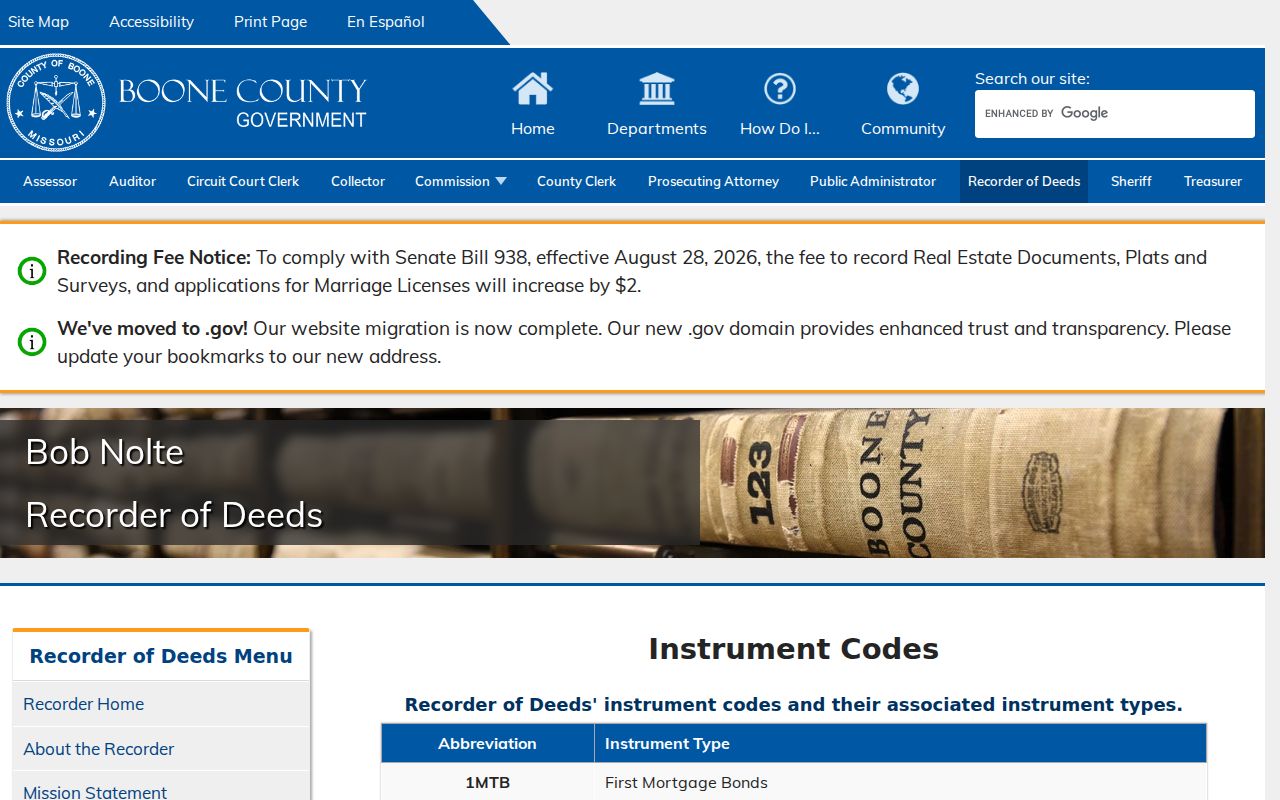
The code list keeps financing, release, survey, and transfer documents from being mistaken for the same type of event. Read the document image and legal description before placing it in the ownership sequence.
Columbia's 1965 Recorder Divide
Boone's online access has an important split. Registered users can search the index and view real-estate images online from 1965 forward. Handwritten index images reach from 1821 through 1965, but most pre-1965 document images require a subscription or a public terminal. Index searching itself does not require that subscription. This is the central numbers-based caution in a Columbia previous residents search: the searchable index is older than the readily available document image.
The Boone iCounty access page shows the subscription and pay-per-page image environment. For an older deed, the Recorder can also be approached through its public terminal, by phone or in person, or with the real-estate copy request form. The form uses book/page, document type, page count, delivery, and certification choices, so finding the index citation first makes the request more precise.
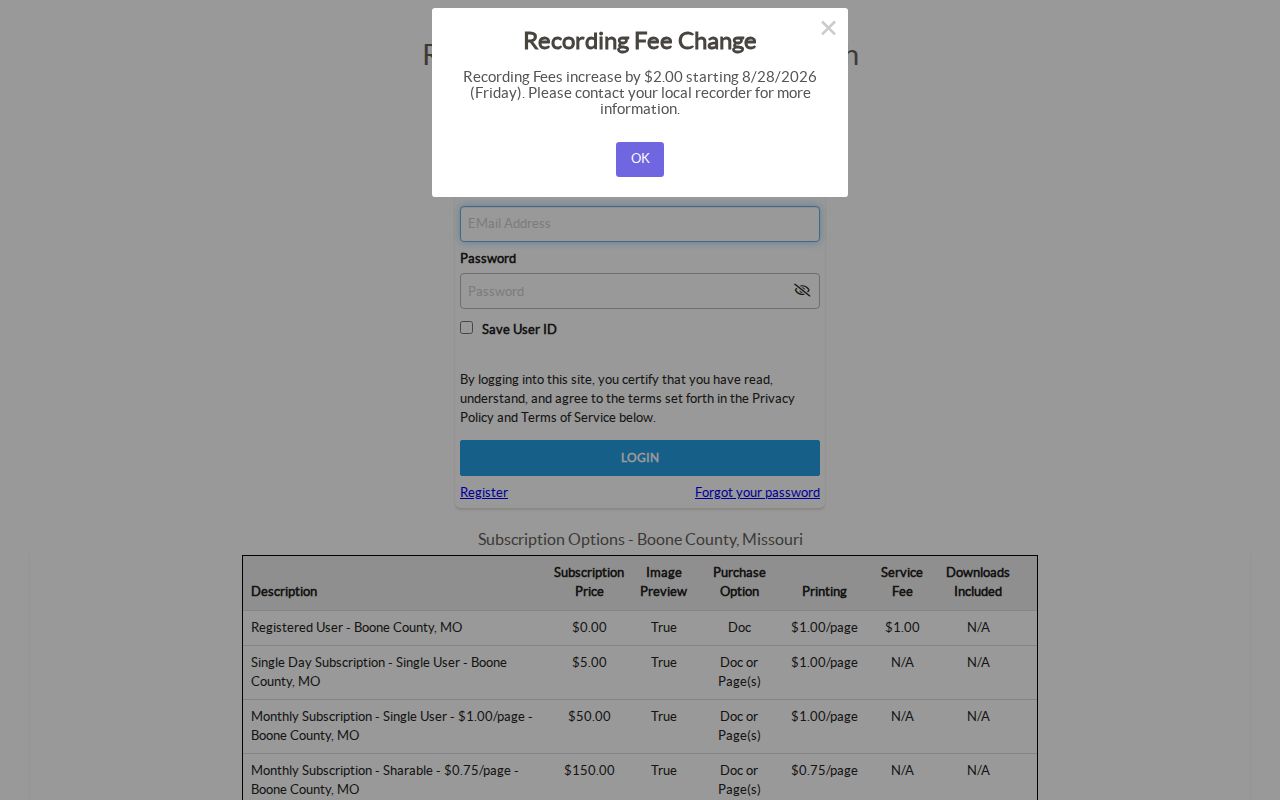
The access screen is a reminder to separate free index research from document-image access. Ask the Recorder to confirm the current route and page count before paying for a copy.
Note: The Recorder's older-index instructions use a first-letter-plus-vowel convention for many surnames from G onward, such as Smith entered as SI.
Columbia Previous Residents Archive Backstop
When a trail reaches beyond the web image period, the State Historical Society of Missouri's Boone County Recorder collection, C3306, is the deeper backstop. It covers 1820-1929 and includes land grants, deeds, wills, and mortgages, arranged chronologically by decade and alphabetically by seller within a decade. Boone County's record books begin with the county's organization era, so an early land trail may predate the modern Columbia address system.
The Boone County History & Culture Center also reports early county records beginning in 1821, a research and genealogy library, and a digital-imaging lab. That institutional history is useful when a prior owner appears only through a legal description or an early county record. It is not evidence that a particular person lived at a current street address.
Columbia Address History Maps
For a physical continuity check, open the digitized Columbia December 1889 Sanborn Sheet 3. Sanborn maps record building size, use, material, water mains, hydrants, and street labels. They are especially valuable where a later address may represent a rebuilt structure, an addition, or a new parcel. A map does not name occupants, but it can test whether a directory address and a present parcel describe the same built place.
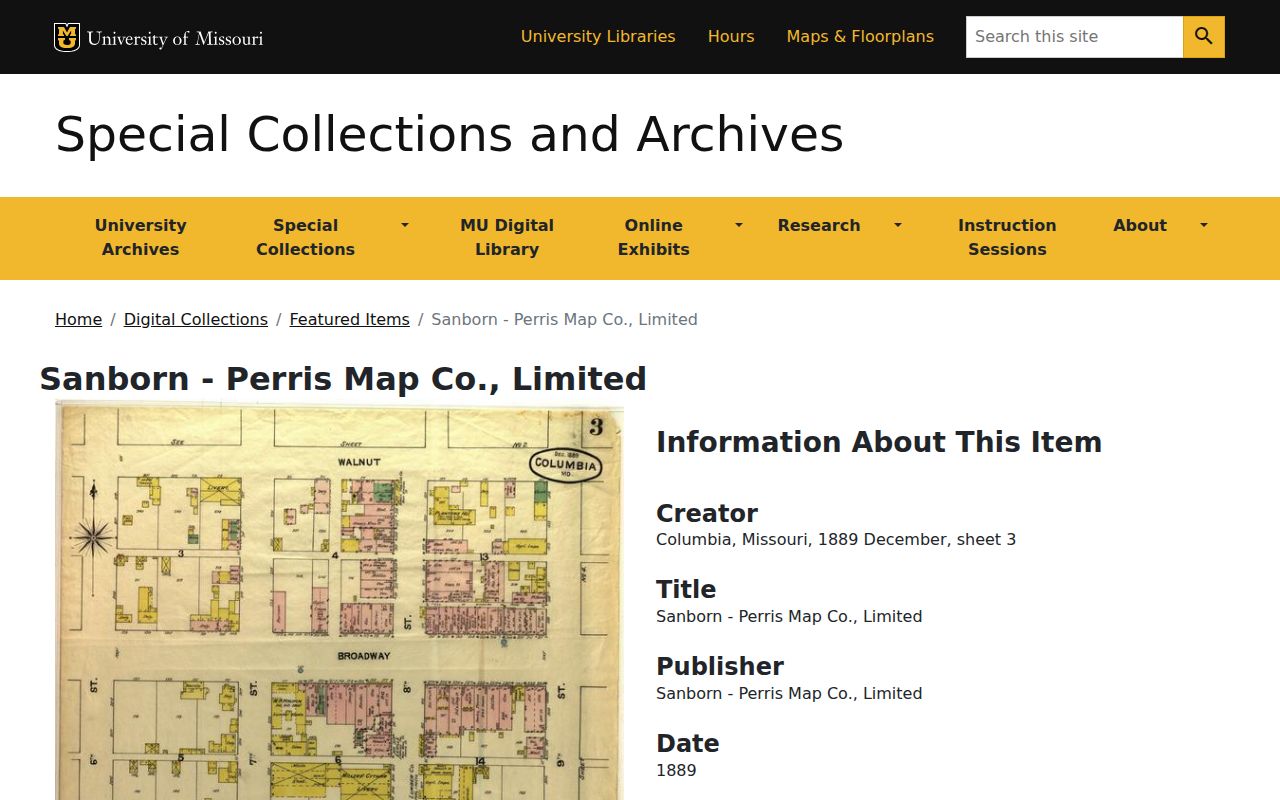
The 1889 sheet names Walnut, Broadway, Cherry, Locust, and Sixth through Ninth streets. Columbia-specific historical references also identify 1908, 1914, 1925, 1931, and 1948 Sanborn material, creating useful points to compare a house history over time.
Annexation and street-name changes can also break a simple address search. Rice Road's change to Geyser Boulevard is documented, but no comprehensive Columbia renumbering table was located. Test former names, street abbreviations, lot and block, and the legal description before deciding the trail stopped.
Columbia House History Support
CoMo Preservation's research resources provide the local house-history route when online searches do not resolve an address. Its guidance directs researchers to the Recorder at 801 E Walnut, Room 132, with a specific book and page when possible, then backward through the records room. Its research library lists city directories, telephone books, Our Town, local obituaries, cemetery records, the 1853 land-entry atlas, and an Illustrated Historical Atlas.
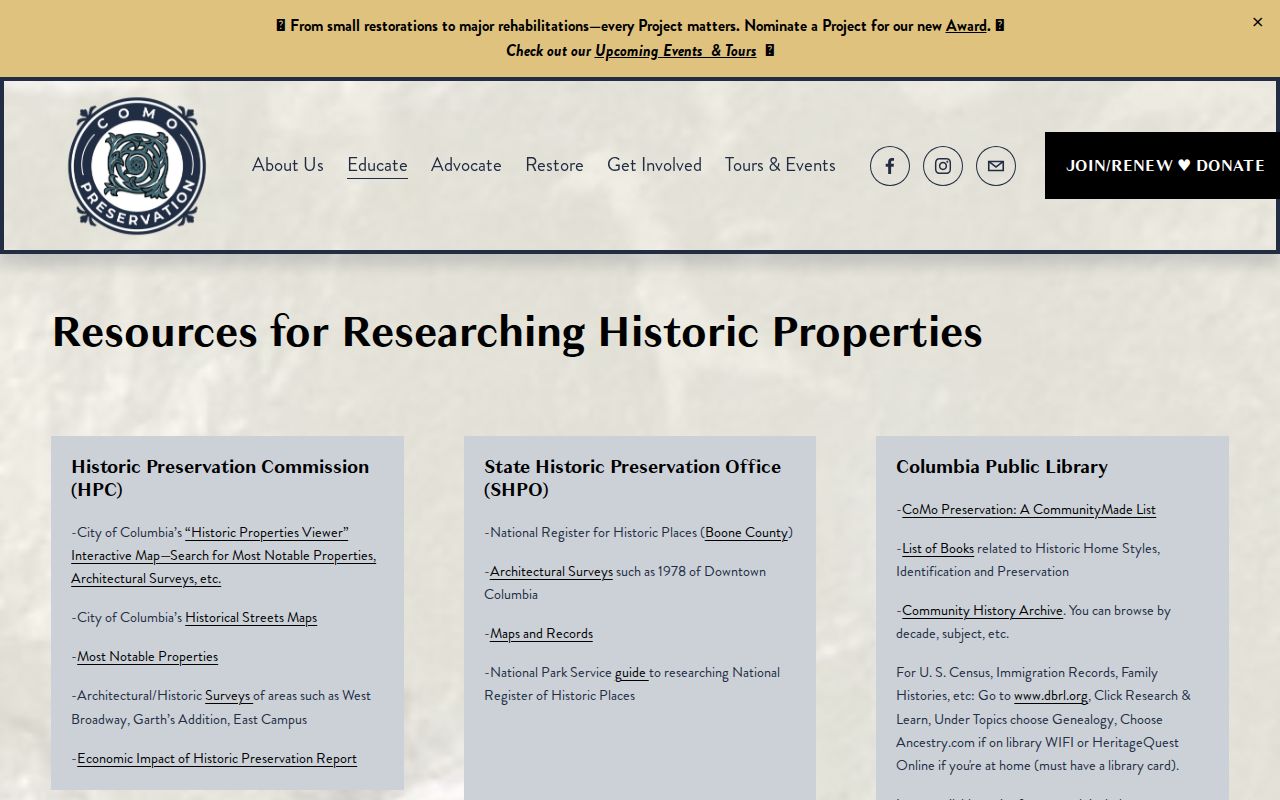
The house-history resource joins paper directories and local reference collections to the Recorder trail. It is a better fallback than guessing from an incomplete online result.
Columbia Previous Residents Households
Ownership is only one layer of past residents. Daniel Boone Regional Library holds physical Columbia directories from 1936 to 2013 with gaps, as well as earlier cited survey runs and telephone directories. Begin with the address or reverse section, then use the alphabetical entry to capture the name, occupation, spouse or relationship notation, and printed address. The collection years, publishers, and shelf details are preserved with the Columbia city directory collections.
Pair each available directory date with the nearest public federal census. DBRL offers HeritageQuest remotely with a library card for the 1790-1950 census; Ancestry Library Edition is limited to library buildings or library Wi-Fi. The directory gives a publisher-time address snapshot. The census identifies the household on its enumeration date. Neither source is a complete modern roster, and gaps between held directory issues must remain visible in the notes.
A compact household flow is address in a later directory, name in the alphabetical section, the nearest earlier held directory, then the matching census year. If a person disappears, try the Columbia Tribune microfilm, which begins in September 1901, the CoMo Preservation obituary collection for 1938-1965, the Missouri death index for 1910-1975, and public probate material where it fits the record question.
Columbia Previous Residents Care
Past residents research is suited to house history, family history, estate questions, and neighborhood history. Each item should carry its source date and its record purpose. A deed confirms a transfer, a map describes a structure, and a directory or census entry places a person in a dated record. When the City is the custodian of a permit or municipal record that is not available in the public search, its public-record request route provides a documented fallback under Missouri's Sunshine Law.
Lawful use. Use Columbia previous residents records for personal, lawful historical research. Do not use a finding to stalk, harass, track, intimidate, or harm any living person.
A missing record can reflect an index gap, a variant name, an old street label, a protected file, a boundary change, or a record held outside the online system. Confirm uncertain results with the office or repository that holds the original.